30 Faceless YouTube Channel Ideas for 2026, Sorted by How You Make Them
Three Things to Know First
- Faceless does not mean effortless. YouTube’s monetization policies now name “inauthentic content” directly, and templated, mass-produced or slideshow-style videos with little original input are not eligible for ads, whether or not a face is in them.
- The cheapest channel to start is the one that uses equipment you already own. A laptop makes screen recordings, a phone on a cheap overhead arm films your hands, and a decent microphone carries narration over footage.
- Pick a format you can repeat weekly for a year. Every idea below is written with the repeatable version in mind, not the one-off viral version.
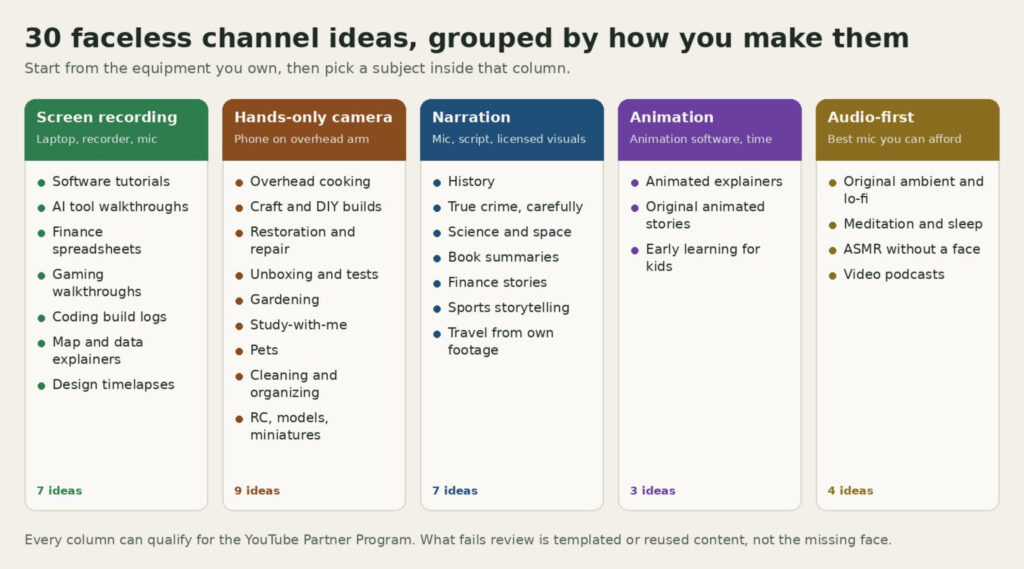
Most lists of faceless YouTube channel ideas sort them by niche: finance, history, gaming, and so on. That is useful if you already know your subject, but it skips the question that actually decides whether a channel gets made, which is how you will produce the videos. A finance channel built on screen recordings is a different job from a finance channel built on narration over stock footage. This guide sorts thirty ideas by production style instead, so you can start from what you have and what you can repeat, then choose a subject inside that style.
Build conversation on your videos.
Real YouTube comments that drive watch time and boost engagement signals.
What Counts as a Faceless Channel in 2026
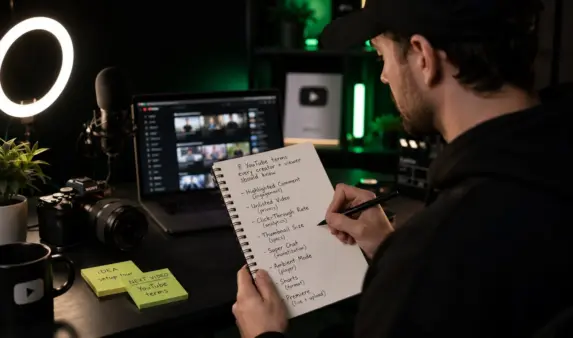
A faceless channel is any channel where the creator is not on camera. That covers screen recordings, hands-only filming, voiceover over footage or images, animation, and audio-first formats. Your voice can be your own, a hired narrator or a synthetic voice. Your name can be real or a channel brand. None of that affects eligibility for the YouTube Partner Program.
What does affect eligibility is originality. YouTube renamed its “repetitious content” monetization policy to “inauthentic content” on July 15, 2025, and clarified that it covers content that is repetitive or mass-produced. The policy page gives examples of what is not allowed to monetize, including image slideshows or scrolling text with minimal narrative, highly similar storyline templates across multiple videos, and AI-generated content made with generic templates that gives the impression of mass production without the creator’s own insight. The separate reused content policy covers compilations, clips and reaction formats that do not add significant commentary or transformation. Both policies are applied to the channel as a whole, so a faceless channel has to show a reviewer what you made and why it is yours. Every idea below passes that test when it is done properly, and the ones with a real risk of failing it are flagged.
Screen Recording Channels
These need a computer, a screen recorder and a microphone. There is no camera, no lighting and no set, which makes them the lowest-cost way to start.
1. Software tutorials for one tool
Pick a single application with a large user base and teach it feature by feature. Spreadsheet programs, design tools, project management apps and video editors all have audiences who search for exact tasks. The repeatable unit is one task per video, titled the way a person would search for it. Monetization leans on search traffic over time rather than viral spikes, which suits the YouTube Partner Program well because watch time accumulates on a back catalog.
2. AI tool walkthroughs
New AI products arrive weekly and most of their users have no idea what the settings do. Record yourself setting up a tool, running a real task and showing the result, including where it fails. The failure footage is what separates this from the hundreds of templated “ten best AI tools” videos that YouTube’s inauthentic content policy is aimed at. Sponsorships from software companies arrive early in this niche, often before ad eligibility.
3. Personal finance with a spreadsheet on screen
Budget templates, debt payoff calculators and investment trackers work well as live spreadsheet sessions where the viewer watches the numbers change. The high advertiser demand in finance is well known, but the spreadsheet format is what makes the channel faceless and repeatable. Keep the examples hypothetical and clearly labeled as education rather than advice.
4. Gaming walkthroughs and lore explainers
Gameplay capture with commentary is the oldest faceless format on YouTube and it still works, especially for games with deep lore or difficult puzzles. The reused content policy is the thing to watch: raw gameplay with no commentary is exactly what reviewers flag. Add your own narration, route decisions and explanations, and the footage becomes yours.
5. Coding and build logs
Record yourself building a small project from an empty file to a working result, narrating decisions as you go. Developers watch these for the reasoning, not the typing, so speed up the typing and slow down the thinking. These channels attract tool and hosting sponsorships and are a natural home for a paid course later.
6. Map and data explainers
Animated maps, charts and timelines can tell stories about geography, elections, trade routes, population shifts or sports seasons without a single frame of camera footage. The production unit is a dataset plus a question. Build the charts yourself in a spreadsheet or a free charting tool, record the screen, and narrate. The originality is in the question and the analysis, which is what keeps these away from the slideshow category.
7. Digital art and design timelapses
Record a drawing, logo, interface or 3D model being built, then speed it up with voiceover explaining the choices. Viewers in this niche buy brushes, courses and prints, so the monetization mix tilts toward products you sell rather than ads alone.
Hands-Only Camera Channels
These need a phone or camera on an overhead arm or tripod, pointing down at a work surface. Your hands are the performer. Natural light from a window is enough to start.
8. Cooking from above
The overhead cooking shot is one of the most reliable faceless formats on the platform. One recipe per video, ingredients laid out, hands doing the work, a short voiceover or on-screen text. The repeatable version is a single cuisine, diet or constraint, such as one-pan meals or meals under a set budget, because that is what turns one-time viewers into subscribers.
9. Craft and DIY builds
Paper crafts, leatherwork, candles, soap, woodworking, sewing and resin all film well from above or from a side tripod. Show the materials, the steps and the finished piece, and resist the urge to cut out the mistakes, because the fix is often the most-watched moment. Affiliate links for materials and your own finished pieces are the usual income sources.
10. Restoration and repair
Take something broken or neglected, show the condition, repair it step by step and show the result. Old tools, furniture, bikes, electronics and shoes all have audiences. The before-and-after structure makes thumbnails easy and gives every video a natural ending.
11. Unboxing and product tests
Hands open the box, set up the product and put it through a few honest tests on camera. The reused content policy is not an issue here because the footage is yours, but viewers can tell a sponsored puff piece from a real test, so keep the tests consistent across products. Affiliate commissions are the obvious monetization, and they pay better than ads at most channel sizes.
12. Gardening and plant care
Potting, propagation, pruning and troubleshooting film naturally without a face, and the subject has a built-in calendar of seasonal videos. Plant channels grow slowly and steadily rather than spiking, and the audience returns for the same problems every spring.
13. Study-with-me and desk sessions
A fixed shot of a desk, a timer on screen, a notebook and pen, with ambient sound or quiet music. These are long videos, often an hour or more, which is good for watch time, and the production is almost nothing once the set is dressed. The channel becomes a habit for viewers who study or work alongside it.
14. Pet channels
Dogs, cats, birds, reptiles and aquariums are watched for the animal, not the owner. Film routines, training, enrichment and the occasional problem solved. Keep it to your own animals and your own footage. The policy risk here is the emotionally manipulative storyline template YouTube names in its inauthentic content examples, so avoid staged peril.
15. Satisfying cleaning and organizing
Deep cleans, decluttering a drawer, reorganizing a pantry or restoring a rug all have audiences who watch for the transformation. Film in real time and speed up the repetitive parts. Brands in the cleaning category sponsor these channels early, and the videos age well.
16. RC vehicles, models and miniatures
Building a model kit, painting miniatures, running RC cars or building a diorama are all hands-and-table formats with loyal audiences and relatively low competition. The hobby has its own product ecosystem, which means affiliate income and manufacturer sponsorships without needing enormous view counts.
Hit the monetization threshold.
Real watch time hours that count toward your YouTube Partner Program eligibility.
Narration Over Footage Channels
These need a microphone, a script and visuals you have the right to use: your own footage, licensed stock, public domain archives or images you create. Writing is the main skill.
17. History told one event at a time
History remains one of the most-watched faceless categories, and the format is simple: a script, archive images or maps, and a narrator. The channel that lasts picks a lane, such as one century, one region or one kind of event, and the video that lasts is the one with a specific question in the title. Image slideshows with a generic AI script are exactly what the inauthentic content policy describes, so the research and the writing have to be yours.
18. True crime and mystery, told carefully
The audience is large and the format is faceless by default. It is also the format most likely to drift into templated storytelling and policy trouble, including advertiser-friendliness limits on graphic detail. Original research from court records and public reporting, a consistent respectful tone and a clear narrative structure are what make a channel in this category sustainable.
19. Science and space explainers
Take one question, answer it in eight to fifteen minutes with diagrams, licensed footage and a clear voice. The subject never runs out, advertiser demand is steady and the audience skews toward long watch sessions. Diagrams you draw yourself, even simple ones, are worth more to a reviewer than stock footage of planets.
20. Book summaries and reading guides
Summarize one book per video with your own reading of what matters and who it is for. The field is crowded with scripted summaries that all sound alike, which is why a specific point of view and a consistent book category are what grow a channel. Affiliate links for the books are the baseline income, with courses and reading lists as products.
21. Finance and economics stories
Instead of spreadsheets, this version tells the story behind a company, a bubble, a bankruptcy or a market event with footage and charts. It overlaps with idea 3 in subject but not in production, and many creators run both formats on one channel. Advertiser demand in finance is strong, and the story format earns longer watch times than tips videos.
22. Sports storytelling
Careers, seasons, rivalries, tactical breakdowns and what-happened-next stories with licensed or public footage and your narration. Broadcast footage is heavily protected, so the sustainable version leans on stills, your own graphics and analysis rather than match clips, which also keeps you clear of the reused content policy.
23. Travel guides from your own footage
Film the place, not yourself. Street scenes, food, transport, prices and practical details with narration added later. Travel channels monetize through ads, tourism board sponsorships and affiliate bookings, and the footage is yours by definition. The constraint is that you need to travel, so the repeatable version is often a single city or region covered in depth.
Animation and Motion Graphics Channels
These need animation software and time. They have the highest production cost per minute of any faceless format and some of the strongest audience loyalty.
24. Animated explainers
Explain a concept in science, economics, psychology or technology with simple animated characters and diagrams. The most successful channels in this category took years to build their style, and that style is their moat. Start with a limited palette and a small set of reusable assets, and let the writing carry the early videos.
25. Original animated stories
Short fiction, comedy sketches or serialized stories in any animation style you can sustain. This is the one format on this list with real merchandise potential, because characters sell. It is also slow: even simple animation takes days per minute of output, so plan a release schedule you can keep.
26. Early learning for children
Counting, letters, colors, shapes and songs with animated characters. The audience is enormous and the format is faceless by nature, but children’s content on YouTube carries its own rules. Made-for-kids videos have limited features and different ad treatment, and YouTube’s quality principles for kids and family content specifically penalize keyword stuffing and low-value repetitive uploads. Treat this as an education channel first and a traffic play never.
Audio-First Channels
These need good audio above everything else, with simple or static visuals. They earn through long watch sessions, loops and repeat listening.
27. Ambient and lo-fi music with original tracks
Study beats, rain sounds, café ambience and sleep audio run for hours and get replayed. The catch is rights: uploading music you licensed from a library can run into the reused content policy and Content ID claims. Composing or commissioning original tracks, even simple ones, is what turns this from a risky channel into an asset you own.
28. Guided meditation and sleep stories
A calm voice, a script and a slow-moving visual. Episodes are long and listened to repeatedly, which suits watch-time thresholds and keeps viewers in the channel. Scripts need to be your own and the voice needs to be consistent, whether it is yours or a hired narrator.
29. ASMR without a face
Tapping, brushing, page turning, keyboard sounds and whispered narration film well as hands-only or object-only shots with a sensitive microphone. Audio quality is the whole product here, so budget for the microphone before anything else.
30. Video podcasts and interviews with audiograms
Record conversations with guests, publish the audio with a waveform or a simple animated visual, and cut the best moments into Shorts. If you are camera-shy but comfortable talking, this is the fastest way to build a faceless channel with a personality. The interview format also brings each guest’s audience to your channel.
How to Choose Between Them
Start from your equipment and your schedule, not from the niche with the highest ad rates. A screen recording channel can be made in the evenings with a laptop. A hands-only channel needs daylight or a lamp and a clear table. A narration channel needs a quiet hour to record and several more to write and edit. An animation channel needs many hours per video. Being honest about this at the start is the difference between channels that reach fifty videos and channels that stop at six.
Then check demand the simple way: search YouTube for the kind of video you intend to make and look at what already exists. If the top results are old, thin or templated, there is room. If they are excellent and recent, you need a sharper angle, not a better microphone. Our guide to why Shorts stop getting views covers how niche switching and saturation hurt new channels, and it applies to long-form as well.
Finally, choose the repeatable unit. One recipe, one task, one event, one book, one match. A channel is a series, and viewers subscribe to series. The thumbnail and title system follows from that unit; if you are unsure how to make a consistent look without a face in the frame, our list of fonts for YouTube thumbnails is a practical starting point.
What You Actually Need, by Style
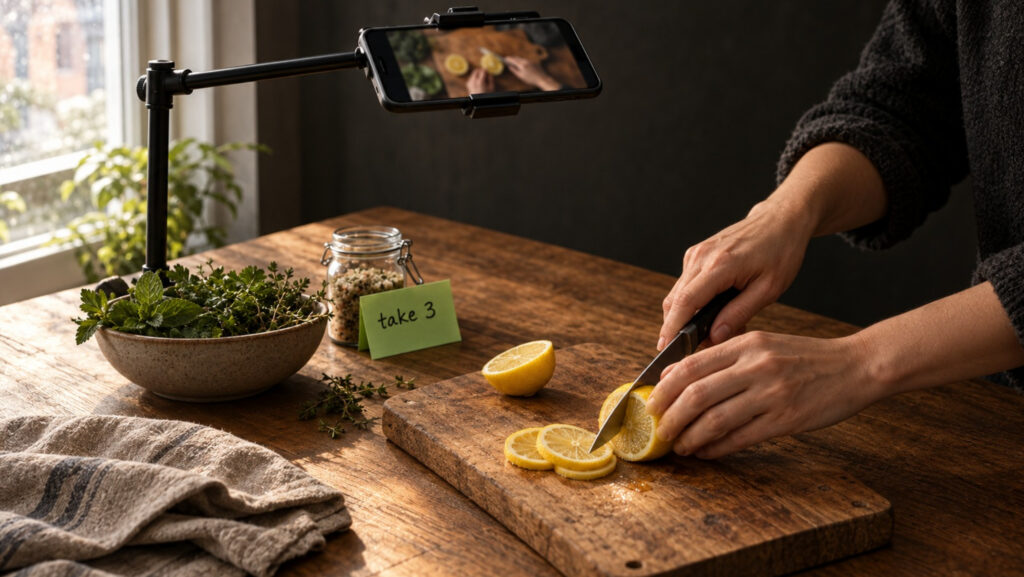
Screen recording channels need a screen recorder, a USB microphone and basic editing software. Many computers have a recorder built in. Hands-only channels need a phone, an overhead arm or tripod and a window; a clip-on lavalier microphone helps if you narrate live. Narration channels need a quiet room, a microphone, a script and visuals you have the right to use, which means your own footage, licensed stock with a clear license, or public domain archives. Animation channels need animation software and either drawing skill or a library of assets you build yourself. Audio-first channels need the best microphone you can afford and a simple visual loop.
Synthetic voices are allowed and widely used. YouTube requires creators to disclose AI-generated or altered content that seems realistic, which its help center defines as making a real person appear to say or do something they did not, altering footage of a real event or place, generating a realistic scene that did not occur, or creating music that is the main focus of the video; when you tick that box at upload, a label is added to the video. A synthetic narrator reading your own script over your own visuals does not fall under that definition, while an ambient channel built on generated music does. Either way, a synthetic narrator reading a generated script over generated images is the combination the inauthentic content policy describes. The voice is not the problem. The absence of a person’s judgement is.
Making Money Without Showing Your Face
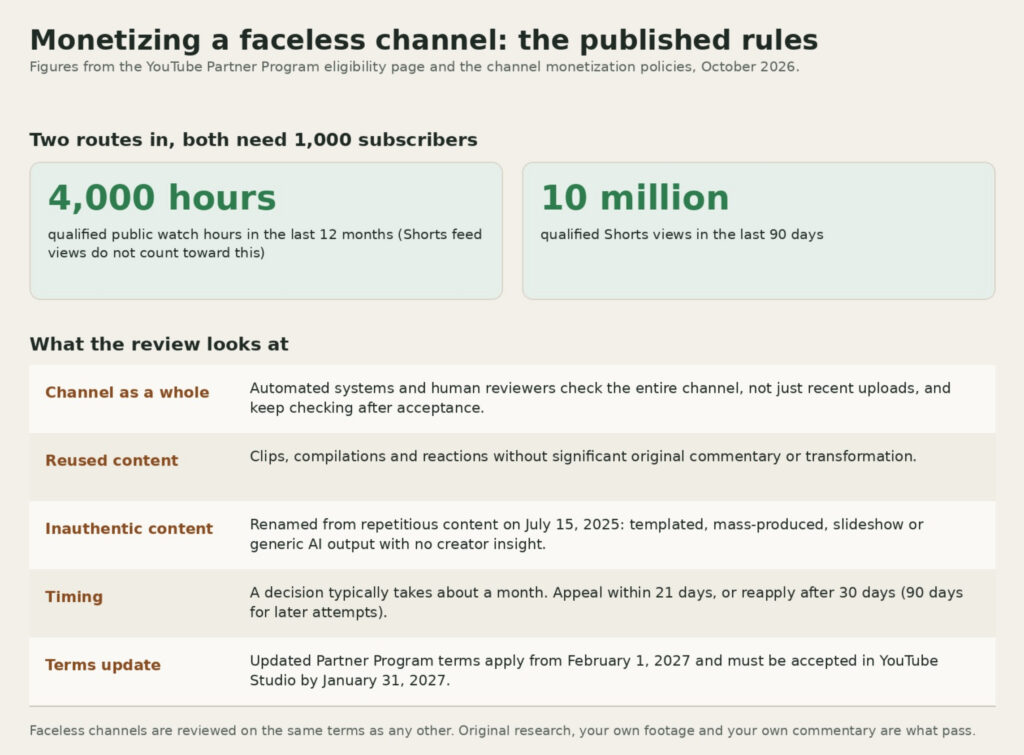
The YouTube Partner Program is open to faceless channels on the same terms as any other. YouTube’s current eligibility page lists two routes once the policy requirements are met: 1,000 subscribers with 4,000 qualified public watch hours in the last 12 months, or 1,000 subscribers with 10 million qualified Shorts views in the last 90 days. Watch hours from Shorts in the Shorts feed do not count toward the 4,000-hour threshold. The same page notes that updated Partner Program terms take effect on February 1, 2027 and must be accepted in YouTube Studio by January 31, 2027 to keep monetizing fully, so a channel starting now should plan to read and accept them.
Review is channel-wide. YouTube says automated systems and human reviewers look at the channel as a whole, typically take about a month, and keep checking channels after acceptance. If a first application fails, you can appeal within 21 days or reapply after 30 days, and after 90 days for subsequent attempts. For a faceless channel, the most common reasons for a refusal are the reused and inauthentic content policies described above, which is why the ideas in this guide keep emphasizing original research, your own footage and your own commentary.
Ads are rarely the biggest line on a faceless channel’s income statement. Affiliate commissions suit review, tutorial, craft and book channels. Sponsorships arrive once a channel has a defined audience, and sponsors care about the audience rather than the host’s face. Digital products, from templates and presets to courses and printables, suit tutorial and finance channels, and merchandise suits animated characters. Channel memberships and Super Thanks become available inside the Partner Program and work best for study, ambient and podcast channels where viewers return daily. Our guide to your first YouTube Play Button explains what happens at the 100,000-subscriber milestone, which many faceless channels reach without a single on-camera appearance.
Getting the First Videos Seen
The first twenty videos of any channel are the hardest to get in front of people, and faceless channels have no personal network of fans to lean on. Consistent titles, a recognizable thumbnail style and one clear subject help YouTube understand who to show the videos to. Cutting a Short from each long video gives the channel a second entry point. Replying to every early comment tells the system the channel is active and tells the viewer there is a person behind it.
If you want to give the first uploads a visible base of engagement while the catalog grows, BuzzVoice offers YouTube subscribers and YouTube views delivered gradually from real accounts, which suits a new channel better than any sudden spike.
Frequently Asked Questions
What is the best content for a faceless YouTube channel?
The best content is the kind you can produce every week with equipment you already have, on a subject with searchable demand. Software tutorials, overhead cooking, history explainers and study-with-me sessions are the formats that most often get past the first twenty videos, because each one has a simple repeatable unit.
Can a faceless channel join the YouTube Partner Program?
Yes, on the same terms as any channel: 1,000 subscribers plus either 4,000 qualified public watch hours in 12 months or 10 million qualified Shorts views in 90 days, no active Community Guidelines strikes, 2-Step Verification and an AdSense for YouTube account. The channel also has to pass YouTube’s reused and inauthentic content policies, which is where faceless channels built on templates fail.
Do I need my own voice?
No. Hired narrators and synthetic voices are both allowed. YouTube’s disclosure rule applies to realistic AI content such as fabricated scenes, altered footage of real events or AI music as the main focus, not to a synthetic voice reading your own script. What matters to the review is whether the script, research and visuals show your own work.
Is YouTube automation the same as a faceless channel?
No. A faceless channel is any channel where the creator is off camera. YouTube automation usually means outsourcing or generating every part of the video, which is the production model most at risk under the inauthentic content policy. You can run a faceless channel with a team, but the editorial judgement has to be visible in the result.

BuzzVoice
BuzzVoice is the best place to go when you need instant engagement services on social media. Offering a wide variety of packages for Instagram, Youtube, Facebook, Twitter, Soundcloud & Tiktok.